MIRELICE COLLECTION
Bowling bags
Explore Bowling bags — Handbags. See individual product details, prices and delivery availability.Home / Handbags / Bowling bags
Make the bowling silhouette part of your everyday wardrobe
A defined body, visible handles and a horizontal line give the bowling shape its character. Compare those details with your belongings and everyday clothes.
Close the guide
A bowling bag in a fashion wardrobe is a question of silhouette: a defined body, a horizontal emphasis and carrying details that remain part of the design. It can introduce structure beside relaxed clothing without requiring a large bag. The category should not be confused with specialist equipment for carrying bowling balls or other sports gear. Here the useful questions are about your daily objects, the opening, the handles and the way the shape joins an outfit.
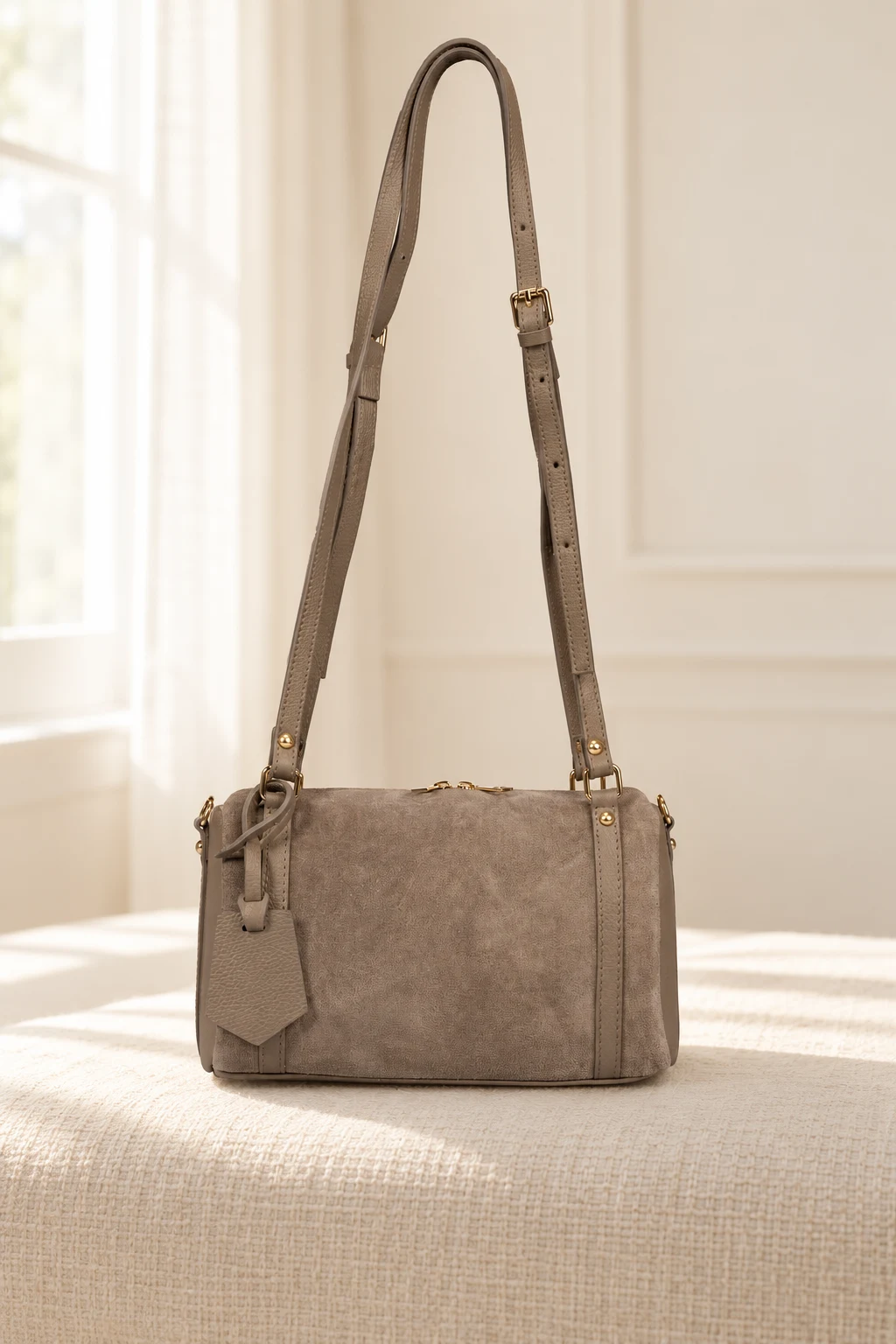
NOOR provides a concrete reference within the MIRELICE selection. The taupe model combines supplier-declared suede and grained calfskin, with recorded exterior dimensions of 26 x 9 x 19 cm and a declared weight of 650 g. Its handle arrangement and zipped organization offer specific points to examine. Start with those confirmed details and your own routine rather than expecting the name bowling to establish one universal capacity or carrying method.
Understand the horizontal line before choosing size
NOOR’s recorded length of 26 cm exceeds its height of 19 cm, so the body has a horizontal emphasis. The 9 cm width supplies another part of the proportion. Looking at these three numbers together is more informative than choosing the largest as a shorthand for spaciousness. They describe the outside of the selected model, not a measured empty rectangle available inside.
Place a familiar bag beside the objects you want to carry and consider how a shorter, defined format would change their arrangement. A long wallet, a rigid glasses case and a small pouch do not occupy space like several soft pieces. The aim is to understand the footprint you need. A compact-looking body can be an intentional choice without being asked to replace a large tote.
Compare the outline with the clothes you repeat
A more defined horizontal shape can create a useful counterpoint beside a loose knit or wide trouser leg. With straight tailoring, the same line may feel quieter and more continuous. These are visual possibilities to explore, not rules about a particular body shape. Look at the whole outfit from a normal distance and decide which relationship you enjoy rather than judging the bag in isolation.
Consider where the handles sit within that picture. Their lines rise above the body and add another dimension to the silhouette. A jacket hem that ends near the top of the bag creates a different arrangement from a long coat behind it. Thinking about those lines helps connect the category to actual clothing instead of choosing an attractive product image without a wardrobe context.
Build a realistic list of everyday essentials
Begin with the phone in its normal case, your preferred wallet or cardholder, keys and any object you genuinely need every time. Add occasional pieces separately so you can see which requirement belongs to most days. A compact bowling shape works best as a deliberate format choice, not as an undefined promise that every possible object will find a place inside.
Measure a rigid essential and compare it with the confirmed opening and interior space where those details are available. Exterior dimensions alone cannot establish a guaranteed fit. Include protective cases and avoid planning an arrangement that requires the zip to be pulled against a packed edge. A little space for your hand to reach an item is part of useful organization, not wasted capacity.
Keep access in the packing plan
Arrange your belongings in the order you need them, with the most frequently used object in a consistent position. If you carry several small cases, check whether they overlap or block the opening. The purpose of this exercise is not to fill every corner. It is to make the contents understandable after several stops, when you want one item without emptying the bag.
Read NOOR’s handle arrangement precisely
The recorded description identifies one detachable top handle and two adjustable long top handles. These are distinct elements of NOOR’s configuration. A detachable handle allows the upper arrangement to change; adjustable long handles provide settings to review. This should not be rewritten as a universal conversion system or as a promise that every bowling bag includes a separate crossbody strap.
Think about which arrangement corresponds to your preferred way of carrying. Handle length, drop and adjustment range are not stated in the available description, so exact shoulder fit needs confirmation for your proportions and clothing. Compare with a familiar bag when possible. The word adjustable is useful information, but it does not identify every possible position or guarantee comfort over any kind of coat.
Make handle settings part of preparation
If you change a detachable element, check that it is correctly secured before heading out. Keep a removed handle together with the bag’s accessories so it can be found when you want the earlier arrangement again. This small routine supports a considered choice of configuration without assigning unconfirmed technical mechanisms to the attachment. Follow the instructions that accompany the actual product.
Set the adjustable long handles deliberately and review the bag with the belongings you normally carry. Clothing thickness changes the space around a handle. A setting that seems suitable beside a fine shirt may feel different over a winter sleeve. Do not turn a photograph of one arrangement into a universal claim about hand, shoulder and crossbody use. Each essential method should be confirmed for this model.
Treat the main zip as the access point
NOOR’s recorded description includes a zip closing the main opening. That tells you about access to the body as a whole. Consider where the opening will be when the bag is carried in your chosen arrangement and what you reach for first. A zipped top has a different sequence of use from a broad flap or a magnetic fastening, so the gesture belongs in the comparison.
Leave room near the opening instead of packing small objects against the zip path. Avoid forcing the closure over a rigid case that presses upwards. A main zip should not be interpreted as evidence of waterproofing, locking or tested protection. It is a confirmed construction detail that helps describe normal use, while those separate functions would need their own product information.
Give each interior pocket a clear role
The available NOOR description records an interior zip pocket and a cellphone pocket. Those spaces have different purposes from the main opening. You might reserve a consistent place for a small item so it is easier to locate, while keeping other belongings in the main area. The useful plan depends on the actual pocket dimensions rather than the number of pockets alone.
A cellphone pocket does not establish compatibility with every phone. Compare your own device including its case before depending on that space. An interior zip pocket likewise needs enough room for the object you want to isolate. Avoid allowing bulky items to press against smaller ones. A simple, repeatable arrangement can matter more than adding extra containers that make the interior difficult to read.
Notice how mixed textures divide the body
NOOR is supplier-described as suede combined with grained calfskin. That is a mixed-material statement rather than a claim that every surface has one uniform finish. The contrast gives the compact form visual depth: a softer-looking panel and more defined leather lines can be read together. Photographs help you see their relationship, while the material declaration comes from the recorded supplier information.
Look at the way the edging and handles frame the larger surface. Against plain clothing, those differences may provide enough detail without another print. Against textured knitwear, you can decide whether the combination feels harmonious or busy. These are styling observations. They do not establish the softness in the hand, an independent quality grade or how the finish will perform in particular weather.
Use taupe as a connection between neutrals
Taupe can link light and dark pieces without becoming the strongest colour in an outfit. Try thinking of NOOR beside ecru trousers and a navy shirt, then beside blue denim and a charcoal jacket. The combinations share a restrained palette but give the bag different surroundings. Start with the tones you actually wear and see where a quieter middle shade would be useful.
A related shoe or belt can connect the look without matching every surface exactly. You can also let the bag stand alone when the clothing already has a clear tonal relationship. Screen settings and lighting affect how the photographed colour appears, so use the product colour description as context. The warm tone of a styled scene is not a promise that the bag will look identical under all lighting.
Balance texture without making everything match
A mixed suede and grained-leather body already introduces more than one surface. With a ribbed knit, wool-like coat or denim, consider which texture should be most noticeable. You may want the bag to act as a quiet link, or to stand against very plain clothing. Neither approach requires an exact matching set of accessories. A small repeated tone can be enough to make the combination feel intentional.
If the outfit contains a pronounced print, leave some visual space around the bag’s own lines. If the clothing is minimal, the contrast between panel and trim can supply the detail. A simple piece of jewelry or an uncomplicated belt may support the look without competing. Judge the result as a whole rather than adding accessories solely to repeat every colour and hardware detail.
Think through a sequence of stops
Imagine an ordinary journey involving transport, a table and a short walk. Where will the bag rest, and which objects need to be accessible at each point? A compact horizontal format may be useful when you want a defined place for essentials. It still needs a packing plan suited to your belongings. The category name does not make every daily task equally convenient.
If your routine changes substantially on some days, allow another bag to serve a different purpose. A day requiring a large folder or extra clothing may call for a different format from a short outing. That does not reduce the value of the smaller choice. It makes its role clearer and avoids selecting an everyday bag according to unusual loads it will rarely carry.
Include the stated weight in the whole load
NOOR’s declared weight is 650 g. Use that as one recorded point in a comparison, then add the actual belongings you plan to carry. The number does not establish maximum load, individual comfort or suitability for a particular physical need. A smaller body is not automatically lighter once the contents and hardware are included, and visual compactness should not replace the available measurement.
Review unnecessary duplicates in your daily selection. A second case, a large key ring or items that are never used may affect the final load more than expected. Choose the bag and contents together. If weight is a decisive requirement, confirm the scope of the figure and compare equivalent data across models rather than treating an absent figure elsewhere as zero.
Compare this format with a tote or crossbody
A tote often makes a broader or taller surface part of the outfit; a compact crossbody may put the relationship between body and long strap first. NOOR’s bowling classification draws attention to its defined horizontal body and particular handles. These are useful differences in emphasis, not rigid rules about who should carry each category. The individual construction still decides the practical details.
Use the same checklist across formats: required objects, outside proportions, confirmed opening, carrying elements, material and weight. If one model lacks information essential to you, keep the question visible rather than borrowing a feature from the other category. A comparison becomes easier when every bag answers the same real task, instead of asking each one to be the largest, smallest and most adaptable at once.
Plan where the bag will be placed
A defined body in a product photo does not guarantee that the bag stands independently in every state. Images may use support or filling to show the outline. Think about the surfaces where you normally put a bag and avoid making upright stability an assumption unless it is confirmed. The shape can be appreciated visually without turning the photograph into a performance test.
Use a clean resting place and keep the body away from spills or rough pressure from other objects. Do not hang an overloaded bag by an unconfirmed attachment simply because it is visible. If a particular way of setting down or storing the bag matters in your routine, ask about that use. Small practical questions are more valuable than an unsupported general claim of robustness.
Care for each finish rather than the whole bag alike
Treat NOOR as a mixed-material accessory. Do not cover every surface with a cream, oil or polish intended for a different finish. The recorded product guidance cautions against wet cleaning and vigorous brushing. Seek instructions suitable for both suede and grained calfskin before choosing a treatment, especially when a mark crosses the boundary between the materials. A generic leather label does not settle the method.
Keep liquids, cosmetics and pens contained so that organization reduces avoidable accidents. If the bag becomes damp, avoid direct heat and obtain material-appropriate guidance. A persistent mark is not a reason to scrub an increasingly large area. These habits help you approach care thoughtfully without promising stain resistance or a particular lifespan. The right method depends on the actual surface and accompanying instructions.
Store removable pieces together
Empty the bag before storage and keep removed carrying elements where they will not be lost. Preserve the natural body shape without compressing the handles under heavy items. Store it dry and avoid prolonged dampness. A simple record of the arrangement you prefer can make it easier to return to it after using another setting, without leaving accessories scattered among unrelated belongings.
Choose a defined role within your wardrobe
Ask what would make you reach for this silhouette rather than another bag you own. It may be the quiet taupe, the contrast of finishes or the preference for a smaller horizontal body. Give that reason a practical companion: a known set of objects, a confirmed handle arrangement and an opening you understand. This creates a clear everyday role rather than a collection of imagined functions.
Return to NOOR’s individual page before making the final choice. Review the exact measurements, materials, pockets and handle description, and clarify any detail that remains essential. A useful bowling bag selection is one you can explain in relation to your own clothes and belongings. The silhouette supplies character; the confirmed information supplies the basis for deciding how it belongs in your day.