Rings
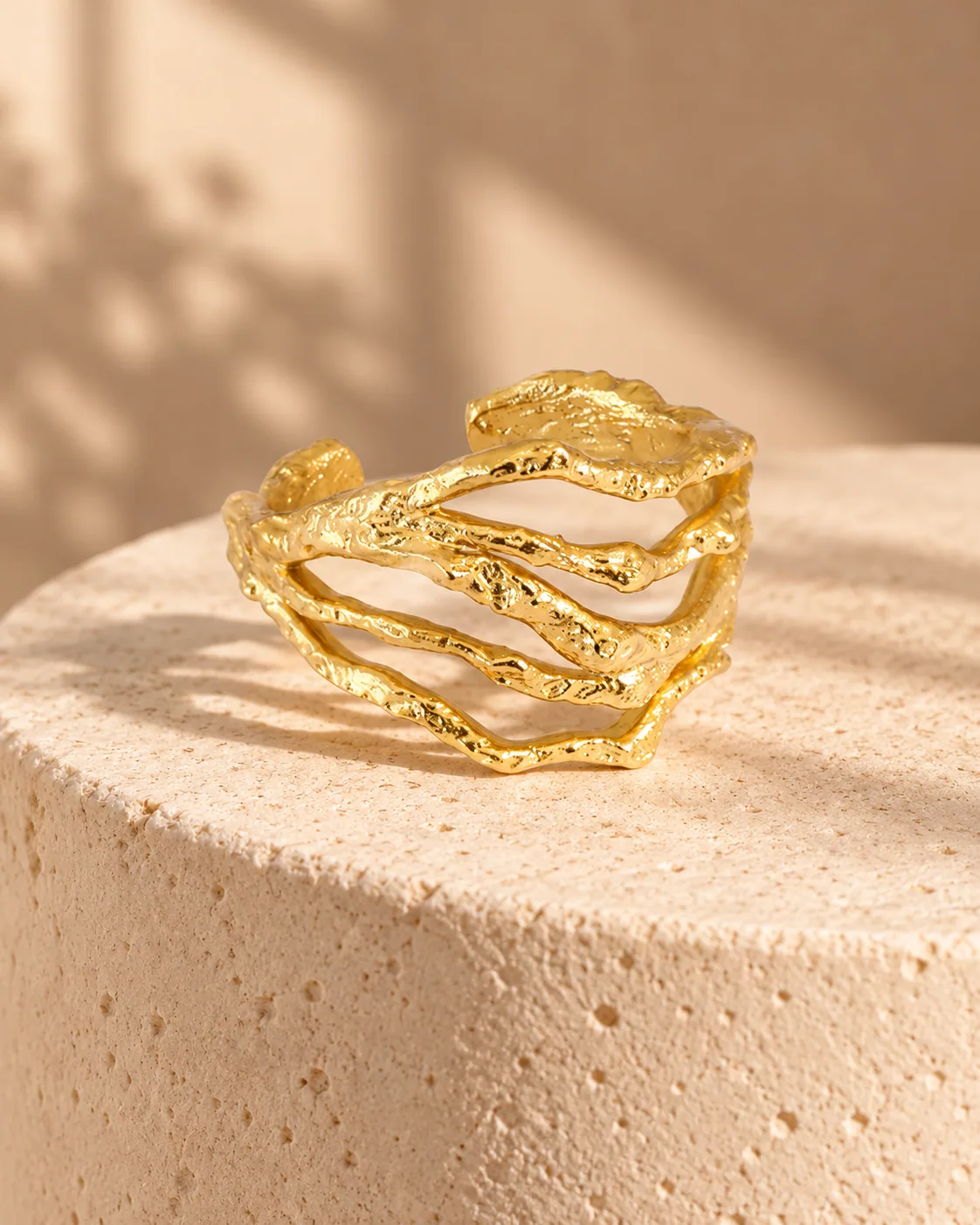
Layered Branch Ring
Preliminary price · taxes and delivery subject to confirmation
Check delivery availability
Delivery availability is not yet confirmed.
Shipping costs and taxes require a confirmed quote.
Details, styling and care
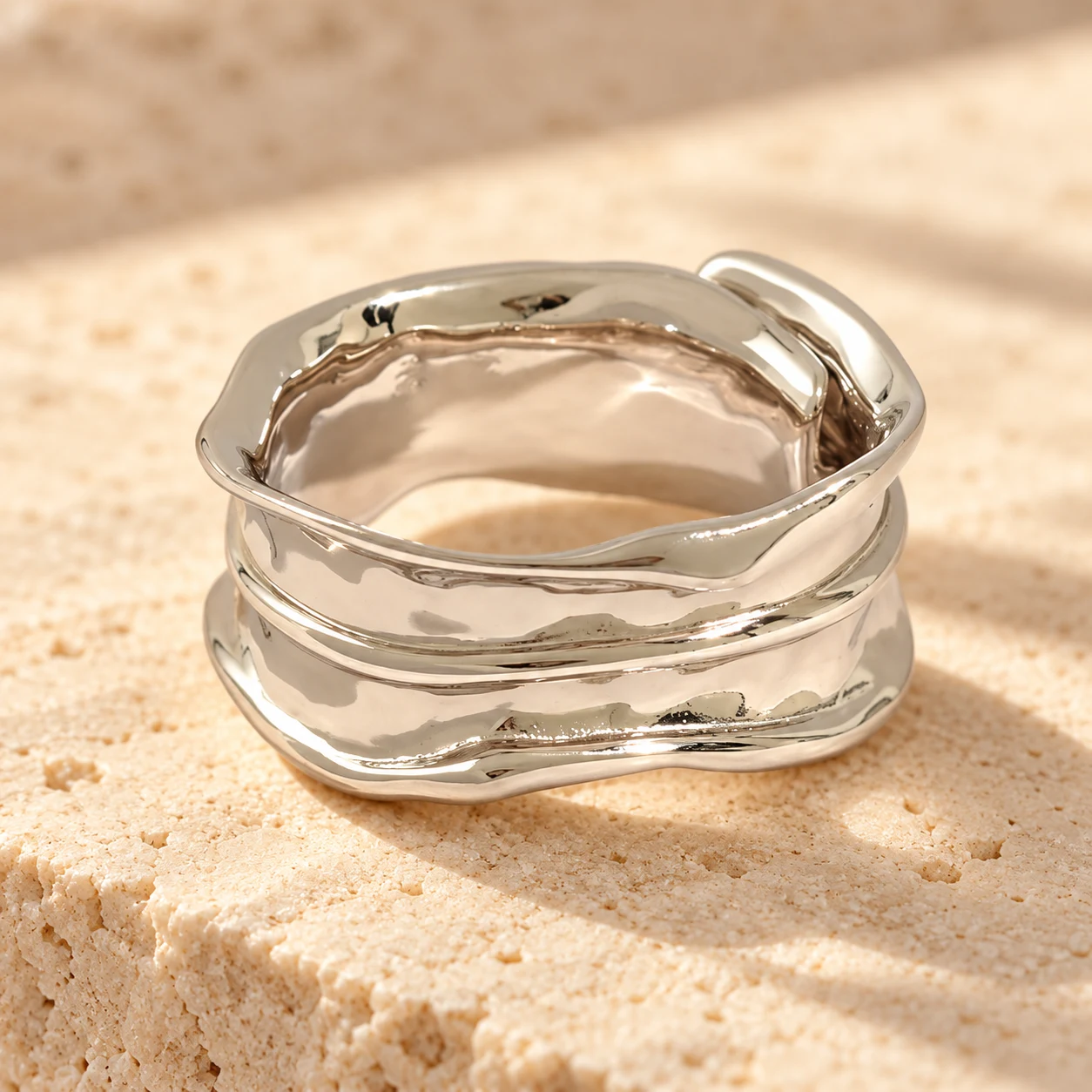
Textured, branch-like lines stack into a wide openwork ring with an irregular outline. The branching silhouette offers an organic contrast to a tailored cuff.
Branch-like lines in an openwork arrangement
The Layered Branch Ring uses textured lines stacked across an openwork front to create an irregular silhouette. The spaces between the lines keep the structure visible rather than presenting one continuous panel. Branch-like describes the design's visual reference, not a particular plant species, natural material or casting process. The selected version is Yellow Gold, and its warm appearance follows the supplier's assigned finish.
A tailored cuff can contrast with the branching shape, while a plain sleeve leaves more attention on the texture. If you prefer other rings nearby, leave enough room that they do not press into the openwork spaces or hide the layered outline. Try the arrangement with your fingers bent as well as straight. The broad front needs its own clearance, and another ring may interact with the branches differently during ordinary movement.
Show less
Declared sterling silver beneath gold plating
The supplier identifies the base as 925 sterling silver with 18K yellow-gold electroplating. The gold description applies to a surface layer rather than solid gold throughout the ring. These are supplier declarations, not independent laboratory findings. The record does not supply plating thickness, complete alloy composition or a separately provided purity certificate. A warm surface is documented, while a guaranteed resistance to scratching or surface change is not.
No main-stone or accent-stone identity is retained. A missing stone field does not prove complete stone absence from every component. The supplier's solid-silver wording also does not independently establish whether the branch-like sections are solid or hollow internally. There is no supported nickel-free, allergy-safe or waterproof assurance. The openwork appearance should not be interpreted as evidence that individual lines can be spread apart or flexed to adjust the fit.
Width, weight range and fit
The source explicitly lists a ring-top width of 15.4 mm and a diameter of 16.9 mm. The width helps you compare the breadth of the layered front with a familiar ring, but does not establish every dimension of the openings or individual branches. The total weight is recorded as a range of 4.8 g to 4.9 g, which should not become a single assumed weight for the selected piece.
Open Size and Adjustable are the supplier's fit descriptions, without a stated safe adjustment range. Check that the ring passes the knuckle without force and that the broad front does not restrict movement or press against adjacent fingers. If adjustment is needed, seek fitting advice rather than pulling the layered lines apart. The visible openings do not make the ring suitable for every size, and repeated bending can alter both its fit and intended silhouette.
Care around the branching spaces
Remove the ring before heavy lifting, exercise, household cleaning or bathing. Allow lotions to absorb before wear and use a soft dry cloth for light marks, following the textured lines gently. Avoid abrasive polish and harsh chemical dips unless compatibility with the plated surface is confirmed. Do not force cloth fibres or sharp tools through small openwork areas; release any caught fabric carefully instead of pulling against a branch.
Store the ring separately from fine chains and other open jewellery that could become intertwined with the layered structure. Support the band when removing it and inspect the outline after a snag or impact. If spacing changes, an edge catches clothing or the fit feels different, set the ring aside for assessment. Keeping the deliberate openwork intact helps distinguish the organic design from accidental distortion.