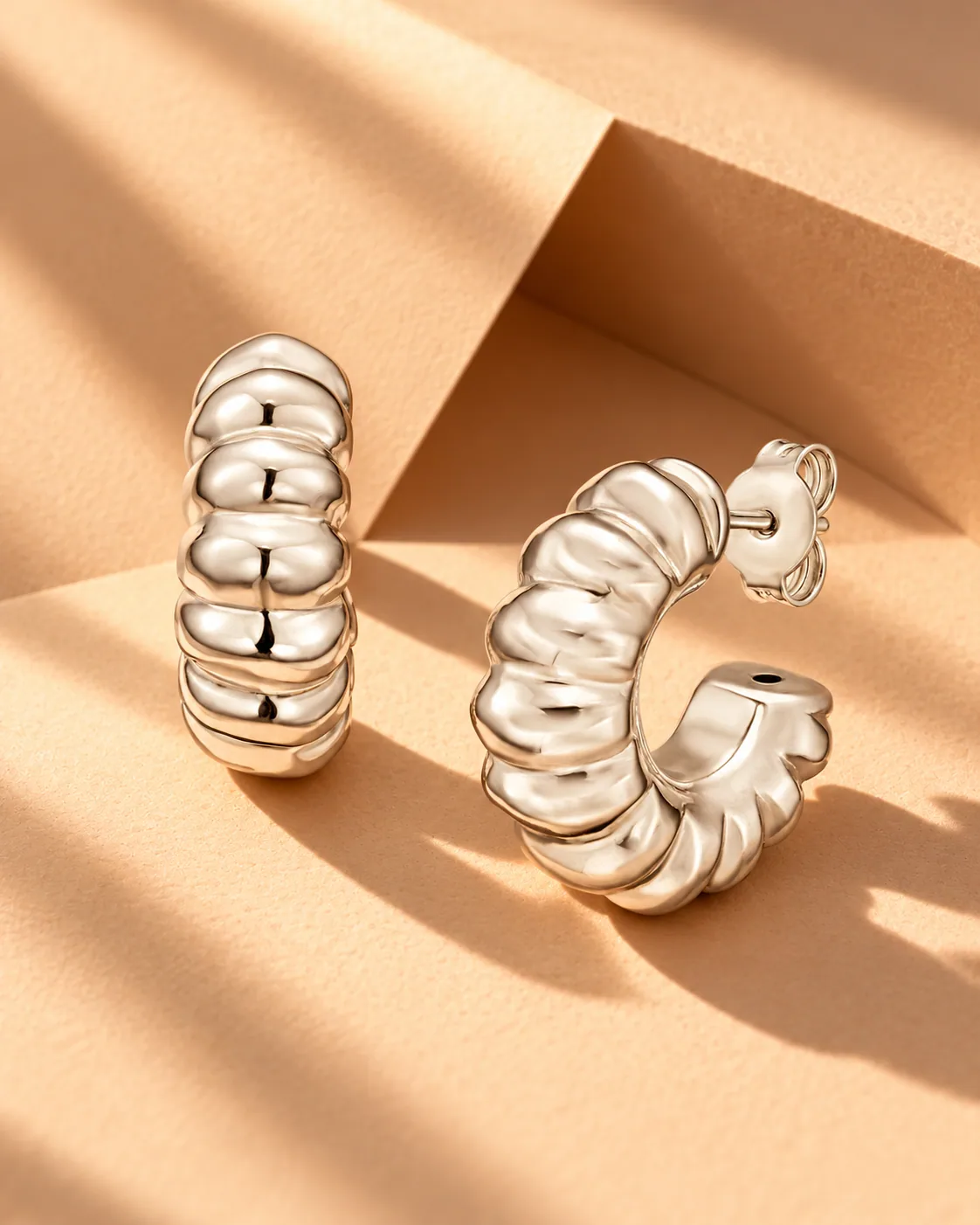
Earrings
Twisted rib C-hoops
Check delivery availability
Delivery availability is not yet confirmed.
Shipping costs and taxes require a confirmed quote.
Details, styling and care
Rounded corrugations wrap these open hoops in rhodium-finished sterling silver. Their closely spaced ridges create a bold profile that contrasts with smooth fabrics.
Rounded ridges wrap an open hoop
The retained introduction describes rounded corrugations closely spaced around open hoops. The repeated ridges give the profile its visual emphasis instead of a separate pendant or a smooth uninterrupted curve. Plain fabrics can provide a quiet background for that texture. Start with the earrings alone near the face before adding another strongly patterned piece that could compete with the rhythm of the raised surface.
Compare the pair from the front and side with your usual hairstyle. Ridges can appear more or less prominent as their angle changes. Twisted is the supplier design name, not an instruction to rotate or reshape the frame. C identifies an open outline rather than a confirmed adjustment mechanism. The bold-looking profile does not establish a particular weight, solid construction or the amount of space the earrings will occupy beside your own lobes.
Show less
The inherited rhodium wording goes beyond the retained title
The exact supplier title describes sterling silver twisted C-hoop earrings. The preserved introduction additionally names a rhodium finish, but no retained product-level specification confirms that coating. Silver fineness, actual finish and the selected variant still require confirmation. Keep the inherited material wording separate from a newly verified plating claim rather than treating a silver-coloured appearance as independent evidence of the complete surface composition.
No coating thickness, full alloy analysis, verified weight or construction diagram is available. Stone information is unknown rather than independently confirmed absent. Raised metal-looking ridges cannot certify the complete pair as stone-free or establish hollow versus solid construction. Another twisted hoop cannot supply missing component facts for this exact model. The title also does not establish whether the ridges are separate elements or how the frame connects to its fastening.
Ask for the real dimensions and closure method
The retained information does not give overall height, width, depth, internal clearance or weight. Ask for actual measurements before comparing the earrings with another hoop or predicting their position beside a collar. A close photograph can exaggerate the ridges without showing the scale of the full frame. The relative description of a bold profile should not become a numeric size or a claim about comfort on every wearer.
Fastening type, post dimensions, backing material and operating instructions are also unavailable. Use the actual closure guidance once confirmed rather than pulling the open ends or squeezing the ridged sides. A hoop name alone does not establish a hinge or click mechanism. If another piercing is part of your intended arrangement, compare real side profiles and spacing so its hardware cannot repeatedly press into the corrugated surface.
Keep the ridged surface free of trapped fibres
Hair moved behind the ear can reveal the whole textured curve, while loose hair may show only short reflective sections. Check the pair with your usual collar, glasses and scarf while turning your head. Put it on after clothing likely to catch the open ends or ridges. Release trapped fibres gently instead of drawing the frame through them, and remove the earrings before activities involving compression or pulling.
Care should follow confirmed instructions for the actual silver, finish and complete assembly. Do not assume abrasive polishing, chemical dips or ultrasound are suitable for the textured surface while those details remain unverified. Store the pair separately so harder jewellery cannot press across the ridges or tangle with the closures. If a curve, surface or fastening changes, seek assessment before further wear rather than reshaping it. Exact dimensions and the inherited rhodium description remain unresolved.