Earrings
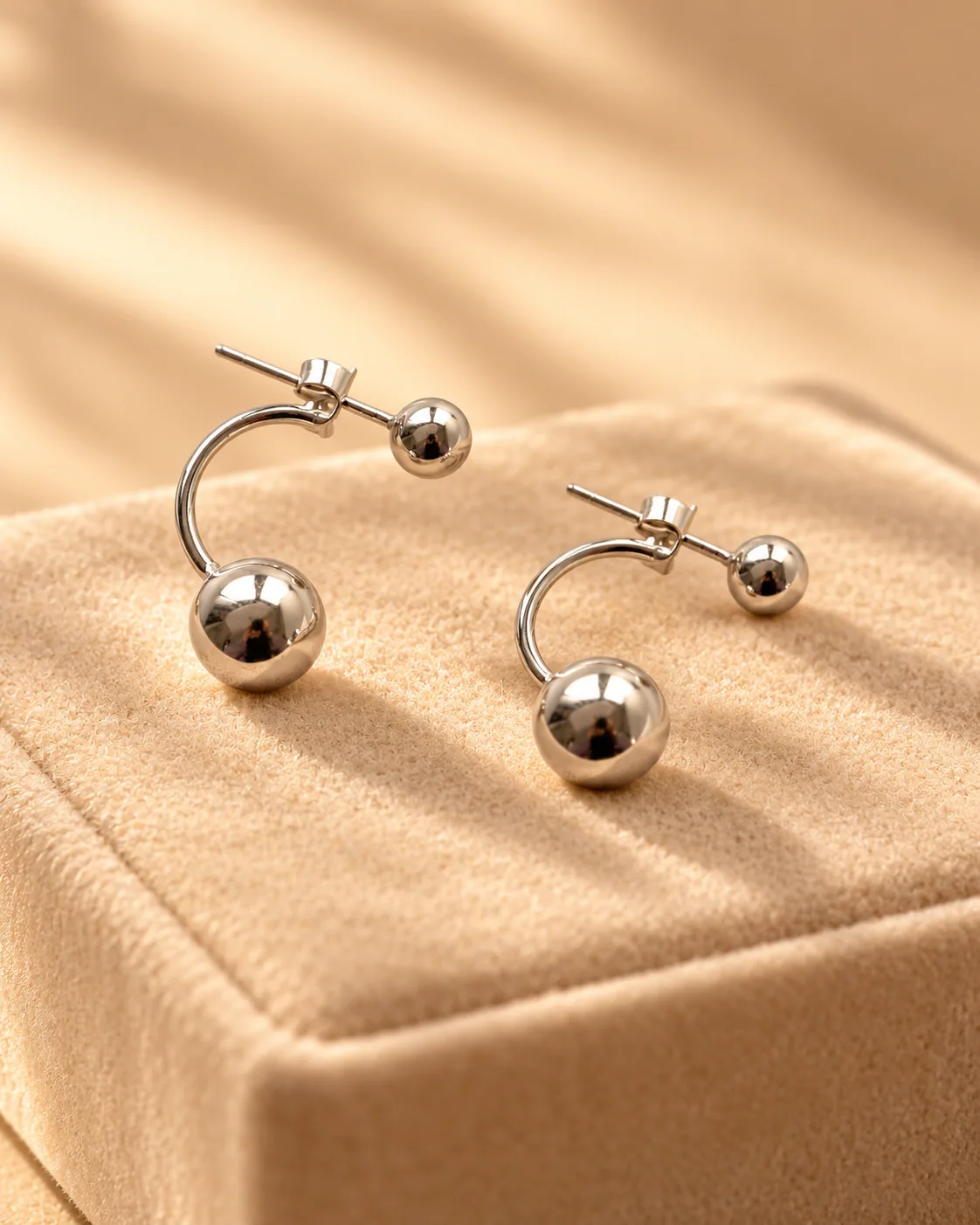
Curved ball stud earrings
Preliminary price · taxes and delivery subject to confirmation
Check delivery availability
Delivery availability is not yet confirmed.
Shipping costs and taxes require a confirmed quote.
Details, styling and care
Unequal polished spheres sit at the ends of a curved stud design, turning simple round forms into an asymmetric detail. Keep the surrounding accessories minimal so the unequal spheres remain easy to distinguish.
Unequal spheres on a curved outline
The Curved Ball Stud Earrings place polished spheres of unequal size at the ends of a curved design. That difference gives simple rounded forms an asymmetric relationship, so the interest comes from their balance rather than a separate decorative motif. The selected version is Rhodium. Sphere describes the visible form and does not establish that the rounded sections are separate beads, pearls or solid metal throughout.
Keep surrounding accessories quiet so the unequal spheres remain easy to distinguish. A plain neckline or smooth necklace can accompany the studs without repeating their entire shape. If another earring sits nearby, leave enough room for the larger rounded element and check the view from the side. The curved profile can occupy space differently from a flat stud, even when the front looks compact in a photograph.
Show less
The stated silver and rhodium treatment
The supplier specifies 925 sterling silver with rhodium electroplating. Rhodium is a surface treatment over the stated silver base, not the composition of the whole earring. These are supplier declarations rather than independent laboratory findings or a separately supplied purity certificate. Plating thickness, full alloy composition and a guaranteed surface lifetime are not recorded in the retained specification.
No main-stone or accent-stone identity is stated. The polished ball appearance should not be turned into a technical guarantee of complete stone absence or a claim of pearl content. The supplier's solid-silver wording also does not independently establish whether the spherical sections are solid or hollow internally. No nickel-free, allergy-safe or waterproof assurance is documented. The curve should be handled as a designed shape rather than assumed to be flexible or adjustable.
Interpreting the combined size entry
The earring-size field reads 5 mm / 8 mm by 10 mm, and the total weight is 2.8 g. The combined size entry is retained without silently assigning every number to a particular sphere, gap or overall axis. It provides a scale reference, but not a complete dimensional diagram. The weight remains the supplier's total figure rather than becoming an assumed weight for each individual earring.
Earring backs are declared as 925 sterling silver. Their exact mechanism and dimensions, along with post length and gauge, are not specified. Compare the overall profile with studs you already find comfortable and check that the actual backing grips securely without compressing the lobe. If a precise ball diameter or particular backing style matters, confirm that detail instead of resolving the combined size entry by visual guesswork.
Keeping the curved form intact
Put the earrings on after fragrance and hair products have dried, and remove them before bathing, swimming, exercise or sleep. Support the main metal structure when removing the backs rather than pulling against a sphere. Use a soft dry cloth for light marks, with gentle pressure around the curve. Avoid abrasive polish and harsh chemical dips unless their suitability for the rhodium surface is confirmed.
Store the pair separately from heavier jewellery that could press against the curved sections. Inspect the outline, posts and fastenings before wear, particularly after a snag or accidental pressure. If the spacing changes or a backing feels insecure, set the earring aside for assessment instead of repeatedly bending it. Preserving the intended relationship between the unequal spheres keeps the asymmetry deliberate rather than the result of distortion.