Earrings
Checkerboard Rounded Rectangle Hoops
Preliminary price · taxes and delivery subject to confirmation
Check delivery availability
Delivery availability is not yet confirmed.
Shipping costs and taxes require a confirmed quote.
Details, styling and care
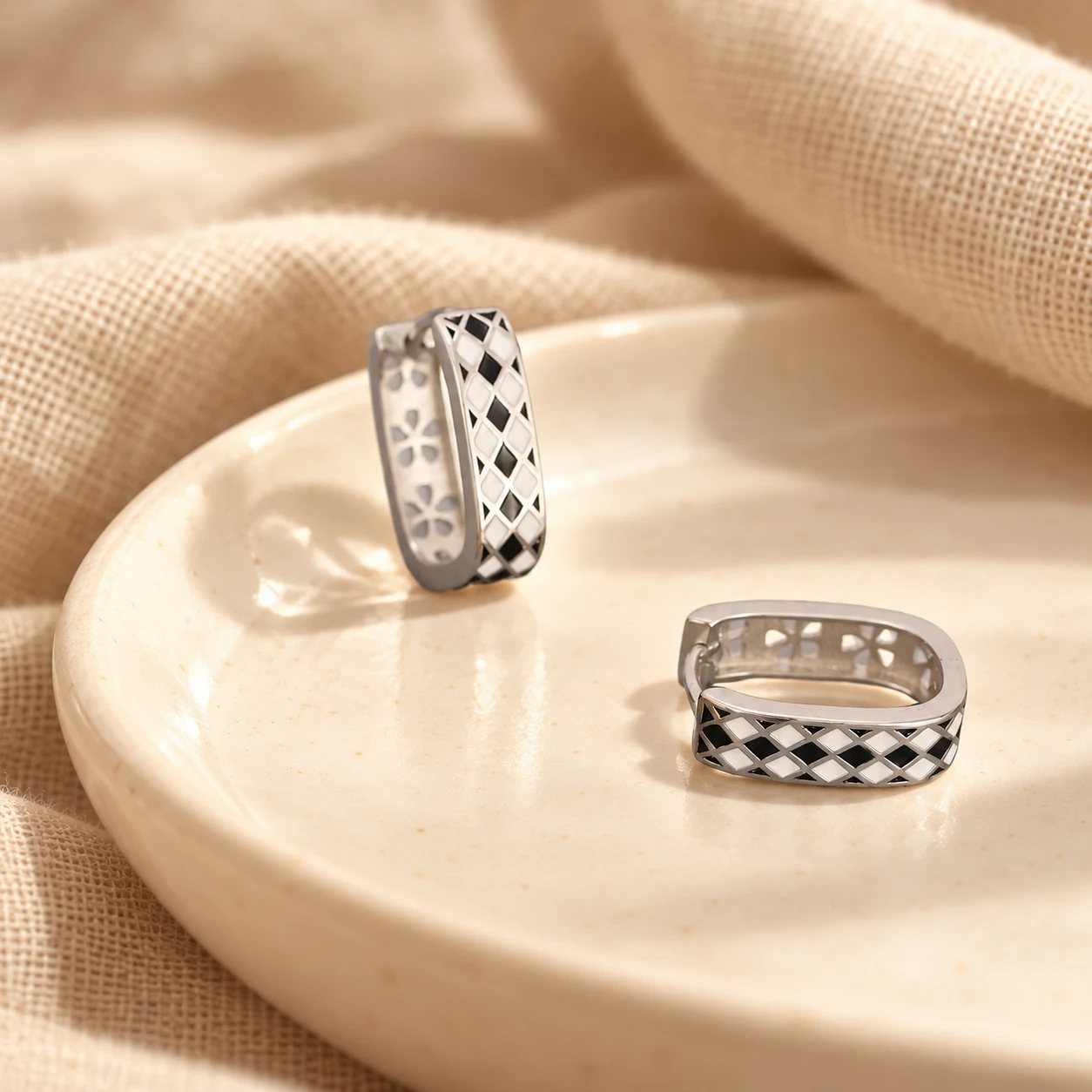
Black-and-white checks follow the rounded rectangular face of these hoops. Keep the outfit simple to give the graphic pattern room.
A graphic pattern on a rounded rectangle
The Checkerboard Rounded Rectangle Hoops bring black-and-white checks to a compact geometric form. Rounded corners soften the rectangular face, while the alternating pattern provides a more graphic detail than a plain surface. The selected variant is Rhodium. The visual description establishes the colour pattern, but it does not identify the material or application method used to create the black and white areas.
A simple outfit gives the checks room to remain distinct. Try them with a plain shirt or a solid-colour neckline rather than a nearby competing print. If you add another piece of jewellery, a smooth band or quiet chain can echo the clean structure without repeating the pattern. Check the earrings from different angles, since the rounded rectangular face and its side profile may have a different presence than a conventional circular hoop.
Show less
Known metal, unknown pattern composition
The supplier specifies 925 sterling silver with rhodium electroplating for the selected version. Rhodium is the stated surface treatment over the silver base, not the composition of the entire earring. These are supplier declarations rather than independent laboratory findings or a separately supplied certificate. No plating thickness, complete alloy analysis or guaranteed surface lifetime is retained in the available specification.
The specification does not identify the substance forming the checkerboard pattern. It should not be described as enamel, epoxy, ceramic, stone or another particular material without further evidence. No stone identity is recorded, and that missing field is not proof of complete stone absence. The supplier's solid-silver wording also does not establish solid internal construction. There is no supported nickel-free, allergy-safe or waterproof assurance for the assembled piece.
Comparing the rectangular proportions
The listed earring size is 15.2 mm by 4.3 mm, with a total weight of 2.67 g. These dimensions provide a reference for the overall design, but they do not separately establish the face width, depth, internal opening or post gauge. The weight remains a total supplier figure rather than being divided into an assumed value for each earring. Use a familiar hoop or stud as a scale comparison alongside the photograph.
A paper outline based on the listed dimensions can help you judge the design near your piercing position. Consider the space needed around the rectangular profile, especially if another earring sits close by. The retained specification does not describe the fastening mechanism. If an exact internal clearance or a particular closure is important, confirm it before using the outer measurements as a complete fitting guide. The graphic pattern explains the appearance, not the mechanics of the fitting.
Care for a mixed-looking surface
Put the earrings on after hair products and fragrance have dried, and remove them before bathing, swimming, exercise or sleep. Begin with a soft dry cloth and gentle pressure for light surface marks. Because the checkerboard material is unspecified, avoid abrasive polish, chemical dips and unconfirmed machine cleaning methods. A treatment suitable for silver alone should not automatically be applied to the patterned surface or the whole assembled earring.
Store the pair separately from harder jewellery that could rub across the checks or rounded edges. Inspect the fastening and patterned face before wear, particularly after a snag or accidental impact. If the surface appears damaged or the closure feels loose, set the earrings aside for assessment instead of applying stronger cleaning products or bending the fitting. Careful handling helps preserve the contrast that makes the design recognisable without assuming a particular pattern material.